
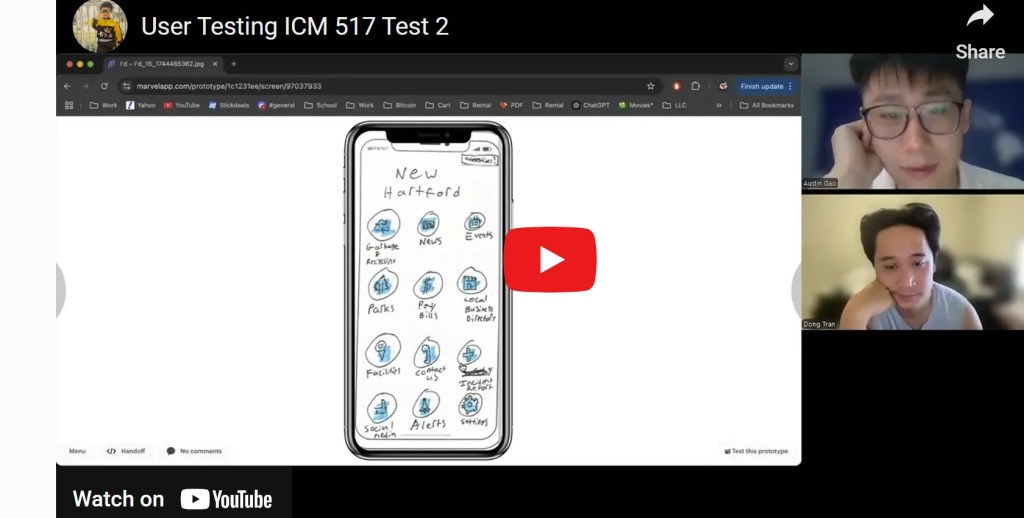
User Testing – What is it?
After developing a low-fidelity prototype of the New Hartford Connect app last week, it’s important to conduct usability tests with real users to see if the product in fact, does meet user needs. But what exactly is a user test? According to the Prototype User Testing Guide by UXTweak, “User testing is the process of evaluating a product by testing it with real users while Usability testing is the specific type of user testing focused on evaluating how easily users can learn and use a product to achieve their goals.”
Tests can be conducted in-person as well as remotely. They can be scripted or unscripted, and all of them have a different motive depending on what you are testing for.
Why do we Test?
By running tests early in the process, we can maximize our chances of meeting user needs and make improvements easily. The goal is to gather as much info as possible so that we can identify problems as early as we can and fix it for a low cost. Imagine taking the time and spending an extensive amount of resources to develop an app that users don’t even find useful!

7 benefits to user testing:
- 1. Improve product, discover new ideas
- 2. Prototype user testing costs less than development
- 3. Save money by avoiding market failure
- 4. Obtain unbiased opinions from users
- 5. Prototype user testing is suitable for all kinds of products
- 6. Quick and easy with modern tools
- 7. Find hidden opportunities
How to conduct a user test
To conduct a user test, there are a couple of elements that we need: a test plan, script, a prototype, and a recording device (if possible). After having obtaining all of those elements, the tester must be prepared by creating a test plan, having the prototype ready, remaining active in obtaining helpful feedback and results and creating a report afterwards.
In UX, there are two primary types of usability tests: a comparative test that are setup to compare different versions of the same thing and exploratory tests that give test participants a realistic scenario and tasks to perform. To prepare for my interviews this week, I developed a test script in the hopes to remain consistent with each of my participants. In a user test, it’s important to not guide the subject too much or else it could create unintentional biases. We want the user to give us honest feedback and not be led directly to our optimal result. Within these tests there are four types of user prototype testing, Low tech prototype interaction and high fidelity prototype user testing which can be moderated or unmoderated.
Conducting a user test in the paper prototyping phase can be advantageous as it is cost effective, easy to adjust, and no coding skills are required.
Usability Tests for New Hartford Connect
By using the platform POP by Marvel, I was able to turn my paper prototypes into actual interactive screens. This then allowed me to test the New Hartford app on two individuals: Shayla and Viet. I decided to test these two users in specific because they are well versed with the town of New Hartford. Shayla is currently a school counselor in town and Trevor has visited the town consistently for years.
For this specific test, I supplied my subjects with 3 main tasks to complete. I wanted to see if my users could figure out how to report a fallen tree on the road (incident tracking), find out what day is garbage day, and how to find a local trail near them.
Results from Usability Tests
After running through the user tests with both Shayla and Viet. I noticed that there were many improvements that could be made to the overall design of the app as well as elements on specific pages to make the whole experience smoother. One large insight that they both pointed out was a way for users to access the home screen whenever they want. Throughout the usability tasks, both of them had trouble resetting back to the home screen after completing the desired task.
Overall I found this part of the design process extremely helpful. There is only so much you can design on your own. Asking real users who are seeing this product for the first time gives an amazing insight to what ideas I drew up in the original low-fidelity prototype as clear and what is not. Allowing me to make tweaks and adjustments as I continue to progress and develop higher fidelity versions of the New Hartford Connect App.
 Grow with Gao
Leave a comment