

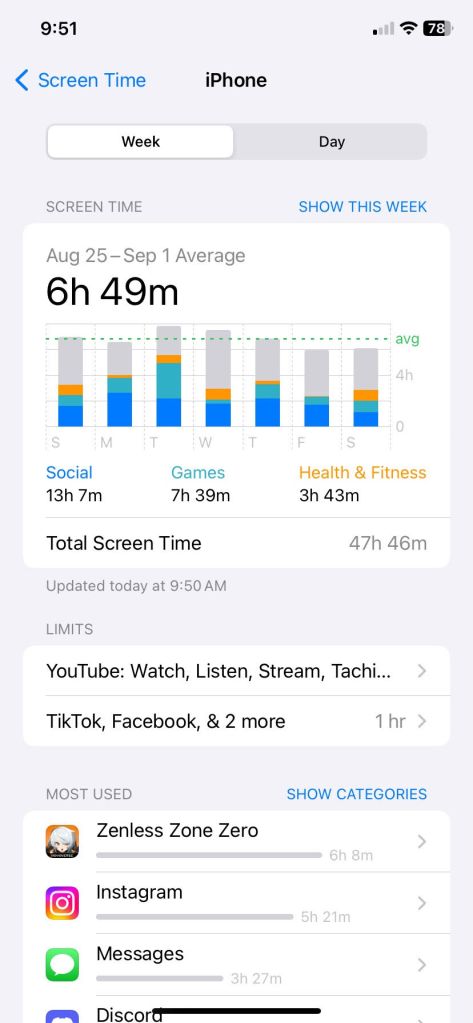
I average just about 7 hours of screen time a day, which equates to about 47 hours a week. Honestly, I’m not surprised by my screen usage, it makes sense since I work in front of one and play games in front of one. Almost everything I do revolves around being in front of a screen all day. This week’s assignment in ICM 501 involves participating in a 5-day digital detox, where we select a digital product in our lives to give up. While I was initially excited to participate in this detox, the thought of actually giving up something built up a feeling of anxiety and despair. Will I be able to conquer this detox or was my whole world going to just end? The thought of giving up something that I use each and every day was crazy to me. Where would I find out news and learn how to do things without YouTube? Where would I go to send my funny videos to without TikTok? In the end, I decided to go for broke and delete both TikTok and YouTube from my phone, two heavy hitters in which I spend a lot of time daily. Thus, my journey began, in reflecting on my addictive behaviors and seeing if I could withstand the entire 5 days or not.
Day 1 was actually quite easy. I’d compare it to a faucet finally being shut off, preventing any more water from gushing out. During the first couple of hours, I felt a sense of releasement. Suddenly, I didn’t have to constantly stay up to date with the latest YouTube videos, maintain my streaks, or react to any messages I’d received. After recently reading Chapters 6 and 7 of Stolen Focus, which primarily focused on the rise of this technology. I realized that these negative effects were too much to ignore. The chapters discuss the rise of Google as well as the many of other Silicon Valley residents that have the power today to shift entire populations and influence our everyday culture. It’s gotten to the point now where companies all have detailed online profiles of ourselves, that know all of our likes, dislikes and everything in between. Scary stuff!
Day Two was a little trickier. Waking up that morning, I felt a sense of withdrawal, like something was missing. I instinctively grabbed my phone in the morning and mindlessly scrolled through it looking for TikTok or YouTube to find a video to start my day. It would continue to happen throughout the day and at times, without me even realizing it. At the beginning of the digital age, digital ethics pioneers such as Tristan Harris and Aza Raskin created features such as the endless scroll to make the technology more intuitive and easier for humans to use/access. However, as the business progressed, companies had to make a decision. Whether to make choices that will make more profit or benefit the health of their clientele.
Days Three and Four felt less icky. My whole body felt like it was slowing down a bit more. Instead of reaching for my phone each and every moment in search of a distraction, I noticed that I began to focus more on tasks and multi tasked less. It was amazing to see how much focused work I was doing at a faster rate than before! These apps that used to trap me in a “Doomscroll” both day and night and distract me from more meaningful tasks were not there anymore. For the first time in years, I felt as if I had finally been unchained. The hold that these apps had on me was finally released and I could now accomplish to-do tasks and goals that I planned to get to for the longest while. The days felt long.
Unfortunately, that euphoria did not last. On Day Five, I felt a sense of excitement and nervousness. My body and mind felt a craving to immediately download YouTube and TikTok and go back to the way I was as soon as the clock hit 12. As a result of this detox, my average screen time and pickups has decreased about 20% down from weeks prior. A dramatic decrease in my daily habits. I also noticed an increase in the quality of work in regular tasks. Within this week, I also felt that I could remember more details since I was distracted less. It’s important to understand that our data is valuable, and that we must be aware of what kind of data we are forgoing when using these products as well as how this data can help us make better choices. Nicholas Felton, an expert at collecting his personal data created an Annual Report of his daily habits for years. With this data, he could more accurately analyze his entire life and make educated choices from his data. In the end, I’m proud that I lasted these five days and am going to take proper steps to reduce activity in the future!
Here are the final results of the detox:
Data Visualization_Gao_2024 by Austin Gao Grow with Gao
Leave a comment